Showing posts with label love. Show all posts

Sunday, October 2, 2016

Earth as God? Not in The Road.


I've always been one of those having "just enough knowledge to be dangerous" guys – a professional armchairist in any number fields: philosophy, religion, music, literature, technology etc. You could say that I tend fly by the seat of my pants, or go with my gut instincts, when seeking explanations of the mysteries of the universe.

As John Lennon sang in the song "The Word:"

Now that I know what I feel must be right
I'm here to show everybody the light

The Beatles were singing about love, of course. Some like to say that God is Love. Others believe that God is Nature. So, what happens when you put those two beliefs together? Do you end up with a starry-eyed, tree-hugging Pantheist spouting Rousseau?
I feel an indescribable ecstasy and delirium in melting, as it were, into the system of beings, in identifying myself with the whole of nature.

Or quoting Nietzsche?

All things are linked, entwined, in love with one another.


I've had fleeting moments of Pantheistic sentiments over the years that, every time they occur, feel as if they must be right. Indeed, it is popular therapy for those struggling with a sense of isolation and disconnectedness to stand barefoot upon the ground (not the pavement) and imagine roots sprouting from the feet into the earth. Think of it as a role-playing exercise where you hug the tree so hard that you become it. Melting, as it were, "into the system of beings."

If God is love and the earth, we can put our seeking to rest. (Ostensibly.) Because here it is, right now, all around us. Relax and sing hallelujah. 

What if the Earth was Dead?

In Cormac McCarthy's Pulitzer-winning post-apocalyptic novel, The Road, (I haven't seen the
movie) the earth is reduced to three things: burned, twisted wreckage and ash, water (as rain, snow, ocean, river etc.), and humans. Almost everything has burned or otherwise been poisoned, and what we assume must be a nuclear-winterish cloud cover prevents whatever seeds or microbes that remain from regenerating. (That is, if we concern ourselves with the science of post-apocalyptic possibilities. McCarthy's vision is pretty convincing, and it's easy to suspend our disbelief and imagine that earth without any life whatsoever save human is possible.)

When there is no earth to sustain humanity, humanity turns upon itself for sustenance. Women are impregnated for the sole purpose of producing food – babies for the barbecue – and roving bands of cannibals round up whatever humans they can find, imprisoning them until it's time for the boiler. 

Civilization, as we know it, is dead. No pantheistic tree-huggers on The Road, no melting into the system of beings, no Tse Chang:

Heaven is my father and Earth is my mother. All people are my brothers and sisters, and all things are my companions.
McCarthy sets up a stark dichotomy between the father and son – who remain nameless as "the man" and "the boy"– as they encounter what remains of the world. The boy, who is born after the apocalypse has begun, has lived it for 10 years. He's seen nothing but death and destruction, yet it is he who feels compassion and sympathy for the lost and haunted humans they encounter on the road. The man, having but one mission – to protect his son – trusts nothing and no one. Yet he tells his son that they must press on, down the road south to the coast, because they "carry the fire." Neither of them seem to know what the "fire" is, but it is revealed, ultimately, as human love, not of God, who has apparently been trying to wipe out the earth and everything, including the humans, on it, but of one another. 

I suspect that Hollywood took McCarthy's poetically-rendered hell-on-earth imagery to create a sensational jaw dropping tear jerker that may have missed the point entirely. McCarthy's work, from Blood Meridian in his early days to No Country for Old Men many years later, has an element of nightmare-inducing horror so graphic as to be unforgettable. (Recall The Judge in Blood Meridian crushing babies heads, breaking necks and sodomizing dead men...you gotta wonder what family life was like for young Cormac.) The devil often wins in McCarthy's stories, or if he doesn't win he exacts a brutal toll, and it takes some digging to find a few slivers of light in his work. 

The Road, even after all the horror, perhaps renders the author's ultimate faith in love more clearly than any of his other work. Like Flannery O' Connor's twisted imagery of the pinpricks of light in the blind eyes of Hazel Moats, the hope for the enduring human love is almost imperceptible. But on The Road, in the end, it is all that is left, and it is up to the "good guys" to preserve it. In the end, love, in the form of compassion for others, is the fire that the boy has carried with him all along. 

What We Feel Must Be Right

Unlike the flora and fauna that surrounds us, we can infer that cycle of life and death is all part of the grand design of an omnipotent creator. Or not. We can put our faith in science to explain the existence of the universe. Either way, we can respect life in all it's forms without assuming that, as humans, we're the bosses, the deciders, the controllers of nature. The earth reminds us of this every time a natural event takes a human life. 

But even if we resist swatting that annoying fly or mosquito, or resist cutting down those trees or damming that river for all the squirrels and fish that will be lost, even if we do everything we can to be in total, complete harmony with nature and, perhaps, in harmony with God, we will have forsaken the fire. That, my friends, is reserved for you and me.

Don't get me wrong. I love trees. I love the flora and fauna, the oceans, the deserts, the plains, the mountains – the whole shebang. 

But I love you more. 


Pantheistic poets - Wordsworth, Coleridge, Goethe, Tennyson, Whitman etc..
A sense sublime
Of something far more deeply interfused,
Whose dwelling is the light of setting suns,
And the round ocean and the living air,
And the blue sky, and in the mind of man.
Hegel: the theology of history
Reason [God] is substance, and infinite power; its own infinite material underlying all the natural and spiritual life which it originates; and the infinite form - that which sets this material in motion.
Ralph Waldo Emerson: the transparent eyeball.
I am nothing! I see all; the currents of the Universal Being circulate through me; I am part or parcel of God.

Friedrich Nietzsche - world and life-affirmer
All things are linked, entwined, in love with one another.

Ernst Haeckel's Monism
In pantheism God is everywhere identical with nature itself  … Pantheism is the world system of the modern scientist.

Modern pantheists

Albert Einstein and the cosmic mystery.
The individual feels … the sublimity and marvellous order which reveal themselves both in nature and in the world of thought. . . He wants to experience the universe as a single significant whole.
 
Robinson Jeffers: Pantheist poet, by John Courtney
The Universe is one being, all its parts are expressions of the same
energy, and they are all in communication with each other.
This whole is so beautiful that I am compelled to love it
and to think of it as divine.
 

Friday, February 14, 2014

Miracles of Love


The End of the Affair 
by Graham Greene
Penguin Classics, 1951
Read by Colin Firth

            It's hard to imagine a more loathsome prick of a protagonist than Maurice Bendrix in Graham Greene's popular early fifties novel, The End of the Affair. It starts with Bendrix hating the married Sarah Miles, the woman he's been sleeping with for the last two years, for breaking off the affair without an explanation. It ends with Bendrix hating God for taking his lover away after a short respiratory illness that could have easily been cured. And in both cases, love is the direct cause of the senseless hate that has poisoned Bendrix, who though a masterful writer of novels is a jealous, heartless, ill-tempered and miserable son-of-a-bitch . If it wasn't for what appears to be genuine concern and compassion for the man he has cuckolded, Henry Miles, Bendrix might be too self-absorbed in his own jealousy to be believable. So too might Sarah Miles professed love for the bastard – what does she see in him? Even if such were the case, the premise of such a passionate relationship breaking out against the backdrop of WWII London (which was directly experienced by Greene and his mistress - Greene's house was destroyed in an air raid) is such a powerful unwritten explanation for the behavior of the characters - all of them - that Bendrix's mad jealousy and possessiveness requires no justification.
            

            The End of the Affair is thought to be one of Greene’s “Catholic” novels (he converted to Catholicism in his early twenties), though the only characteristic of the story that makes it Catholic vs. just generally Christian is that Sarah Miles converts to Catholicism just before her death. Either way, while it would appear that the primary plot element is based on “the affair” that Maurice Bendrix has with Sarah Miles, and more specifically how it ends, (which in and of itself is a heartbreaking story) what the story is really “about” is faith, and not only believing in God but professing love for God and the notion that God’s love is the greatest love of all and can cure the sick and bring the dead back to life. The profound beauty and impact of the novel is in the way Greene tells this very simple love story (though Bendrix thinks he’s telling a “hate” story) and packs this profound, thought-provoking message that, like the speech of Father Zoysima in The Brothers Karamazov, can’t help but cause the reader some serious pause.
        
    From a writer’s perspective there were a couple of things that caught my eye in The End of the Affair -- aside from the beauty of Greene’s prose, his patient revealing of each character’s unique quirks (from Bendrix POV), the spare yet realistic dialogue,  the sense of solid physical location around a Common, and his courageous humanity - all of the things I take for granted and that I sought to employ in my own writing yet so easily forget - aside from all that there are a couple of big capital “T” Techniques at play that I find interesting.

            The first technique is characterized by the first paragraph of the novel:

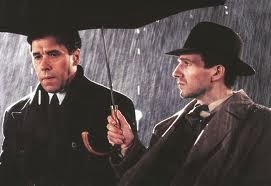
       “A story has no beginning or end: arbitrarily one chooses that moment of experience from which to look back or from which to look ahead. I say “one chooses” with the inaccurate pride of a professional writer who -- when he has been seriously noted at all -- has been praised for his technical ability, but do I in fact of my own will choose that black wet January night on the Common, in 1946, the sight of Henry Miles slanting across the wide river of rain, or did these images choose me? It is convenient, it is correct according to the rules of my craft to begin just there. But if I had believed then in a God, I could also have believed in a hand, plucking at my elbow, a suggestion, “Speak to him: he hasn’t see you yet.’ “(p. 1)


            Having not spent my career in letters I can’t draw from rich mental databases of great first paragraphs to compare with this, but it is certainly an opening paragraph that I will return to again and again.
            The first time through it is a little confusing for the first sentence seems to be a justification for where the narrator has chosen to begin his story, which is not technically the chronological beginning of the events he is going to share with us. Bendrix apparently starts his story here because this is the scene that initiates the detective work, which instantly invests our curiosity. If Greene were to have written a “how-to” book for novelists, he might have said “don’t beat around the bush to get to the suspense and mystery. Airdrop the reader right in there.”
            There’s also some deft foreshadowing:
            “But if I had believed then in a God…” begs the reader to complete the first half of the sentence with “as I do now”, so we can’t help but wonder what is going to push Maurice Bendrix over the edge. We’re also led to understand that our narrator's God has a “hand”, the “hand” of fate, “plucking at my elbow, a suggestion…”. What an amazing image and arresting beginning to Maurice Bendrix’s story - his introduction - to God. And then just a few sentences later Bendrix, in his typically smartass fashion starts to create this image of God as a mischievous troublemaker, which He certainly becomes, to Bendrix anyway:

            God’s suggestion is to go speak to Henry Miles, the man he’s cuckolded for the last several years.
            ‘Speak to him, he hasn’t seen you yet.’ (P. 1) God, the omniscient, knows what Henry has seen and hasn’t seen. That, is IF Bendrix had believed then God MIGHT have known what Henry Miles could see.

“For why should I have spoken to him? If hate is not too large a term to use in relation to any human being, I hated Henry -- I hated his wife Sarah too. And he, I suppose, came soon after the events of that evening to hate me: as he surely at times must have hated his wife and that other, in whom in those days we were lucky enough not to believe.” ( P. 1)

            It’s easy to miss phrases like “in those days” and let an important piece of foreshadowing slip past. Same with “that other”.  I didn’t come to it until I actually read through these first paragraphs several dozen times, knowing how the story turns out. There’s nothing to tell us that Bendrix and Henry Mile’s wife Sarah were lovers, and he’s been jilted and can’t figure out why and even when Sarah explains it to him - that she promised God that she would end the affair if He would save Bendrix’s life - If He would bring him back to life - after he’s crushed by a door during in a bombing raid, Bendrix refuses to believe it.

            So in those first few paragraphs we are dropped into this rainy night on the Common where the narrator is being cajoled by God to go talk to a man he hates, and, that we learn a page or two later, he cuckolded for 2 years, and that the narrator believes that both he and “us”, meaning Henry and Sarah, were “lucky” in years past to have been unbelievers. That’s a pretty meaty morsel to tee up, and if we didn’t know that Greene was one of England’s most popular writers throughout the 20th century we might wonder if all his work was religious. But all we have to do is read the inside of the jacket to know that the spiritual theme took a back seat to other straight-ahead stories throughout his career, and I’ll be interested to see how his secular novels hold up.
            It’s also interesting that Greene chose to begin the story after Bendrix affair with Sarah was over, and Bendrix in his mad jealousy had hired a detective, supposedly on behalf of Henry Miles, to find out who Sarah is sleeping with next. We have no idea why Bendrix is so obsessed, other than he must be a born prick, because we have no idea what Sarah is like. 50 pages later Henry learns that his “friend” Bendrix had a two year fling with his wife several years ago, which prompts the description of “the end of the affair”, when a German “robot” explodes and Bendrix is mortally wounded and possibly brought back to life through Sarah’s promise to God to end the affair. Six months later, the detective Parkis discovers Sarah’s journal, and Bendrix takes it. His intention is to find out who Sarah has been sleeping with, and he does, but only after he realizes that Sarah truly loves him:

“It’s a strange thing to discover and to believe that you are loved, when you know that there is nothing in you for anybody but a parent or a God to love.” (p. 70)

            Sarah’s diary, I read somewhere, is said to be some of Greene’s most powerful prose. It reads like a spoken monologue in the most dramatic sense, much of which is addressed directly to a God:

“...anything left, when we’d finished, but You. For either of us...You were there, teaching us to squander, like You taught the rich man, so that one day we might have nothing left but this love of You. But You are too good to me. When I ask You for pain, You give me peace. Give it him too. Give him my peace - he needs it more.” (p71)


   Diaries and journals are often key components to novels and in The End of the Affair it is the main ingredient. It is the chronicle of a conversion, or a gradual awakening to the existence of a personal God that loves each individual - not “mankind” or “humanity” - but Sarah, Maurice Bendrix, Henry Miles and the injured characters: Richard Smythe and Lance Parkis, whom he cures with good old-fashioned miracles. But even with all this evidence, Bendrix at the end seems like he’s nothing more than pummeled into submission:

“I wrote at the start that this was a record of hate, and walking there beside Henry towards the evening glass of beer, I found the one prayer that seemed to serve the winter mood: O God, You’ve done enough, You’ve robbed me of enough, I’m too tired and old to learn to love, leave me alone for ever.” (P. 160)

            When I heard Colin Firth read those last lines I thought “oh for chrissakes throw the broken bastard a bone, will you?” but I realized that, even though Maurice Bendrix heart, his romance, his physical passion, all of that seems lost in Sarah, we’ve seen this odd friendship grow - a fellowship of sorts, a lonely hearts club - spring up between the husband and the lover, both of whom have been abandoned for the love of God. They will share a few beers and more than a few laughs, which seems a fair substitute for the time being while they think about learning to love again. 


About Graham Greene

This from WikiPedia:
Henry Graham Greene, OMCH, (2 October 1904 – 3 April 1991) was an English writer, playwright and literary critic.[1] His works explore the ambivalent moral and political issues of the modern world. Greene was noted for his ability to combine serious literary acclaim with widespread popularity.
Although Greene objected strongly to being described as a Roman Catholicnovelist rather than as a novelist who happened to be Catholic, Catholic religiousthemes are at the root of much of his writing, especially the four major Catholic novels:Brighton RockThe Power and the GloryThe Heart of the Matter and The End of the Affair.[2] Several works such as The Confidential AgentThe Third Man,The Quiet AmericanOur Man in Havana and The Human Factor also show an avid interest in the workings of international politics and espionage.
Greene suffered from bipolar disorder,[3] which had a profound effect on his writing and personal life. In a letter to his wife Vivien, he told her that he had "a character profoundly antagonistic to ordinary domestic life", and that "unfortunately, the disease is also one's material".[4]William Golding described Greene as "the ultimate chronicler of twentieth-century man's consciousness and anxiety." [5] Greene never received the Nobel Prize in Literature, though he finished runner-up to Ivo Andrić in 1961.[6]