Showing posts with label depression. Show all posts

Wednesday, July 6, 2016

Why Bob Schneider Isn't an International Superstar

Bob Schneider or Downey Jr.?
Why? Because he hasn't changed his name, that's why. It's an:

[oxymoron |ˌäksəˈmôrˌän|
noun

a figure of speech in which apparently contradictory terms appear in conjunction (e.g., faith unfaithful kept him falsely true).]

Okay. Let's look at "Bob Schneider, International Superstar." Or "Bob Schneider, famous singer/songwriter." Oxymoron, right? How can anybody that goes by "Bob Schneider" be an international superstar? 


Bob Schneider, your local State Farm rep.
Bob Schneider, DDS.
Bob Schneider, IRS agent.
Bob Schneider, dairy farmer.
Schneider's Deli

But pop star? Rock star? King of White Boy Funk? I've heard that he's sometimes referred to as B. Schnei on his home turf in Austin, but I'm not sure that'll do it. 

Oh, and there's the Austin factor working against him, too. Everybody knows that Austin cats are
serious players, serious writers, serious poets, seriously eclectic, seriously somewhere in between Nashville, LA and New York: alt indy hanging around their necks like a ball and chain. That's why we love Austin - it's where guys like Bob Schneider can make music and art that's true, honest, unsullied by commercialism. It's probably the only town where a guy could sing a song called "Hanging Out With The Horny Girls" and not get burned at the stake by the political correctors. Bob is certainly doing his part to Keep Austin Weird, as the bumper stickers say.

It seems many of my favorite artists are in the "too good to be famous" category. Years ago I wrote an article for a defunct SF rag about NRBQ and their big label debut release, "Wild Weekend" on Virgin Records. Their's was not an oxymoron problem as much as it was an image problem. Put simply, the boys lacked sex appeal. Same went for Little Feat and Bruce Hornsby, though they were far more popular than either NRBQ or Bob. (I think I just decided to call him Bob. Period.)

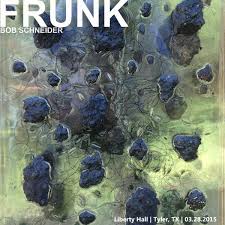
Like NRBQ, I couldn't be happier that Bob isn't an international superstar. I just recently (and very thankfully) discovered his seemingly bottomless, 30 year old catalog. He was the same guy behind the Ugly Americans and one of my top-ten fave rave-ups, "Vulcan Death Grip." After a little browsing around I downloaded about 30 of his songs and have been listening to them multiple times daily ever since. He also records every single one of his shows and, before the audience gets away, has CDs burnt and ready for sale. (He calls these live recordings "Frunk." I don't know why.) 

On his home page he discusses his lack of international superstardom as a voiceover accompanying some of his cool artwork. His theory is that the small skinny rockers get all the attention because their packages are outsized in proportion to their gaunt frames. Big bearlike guys like Bob (and myself, not uncoincidentally) have our stuff hidden between our massive, muscular thighs, so it's practically invisible in comparison. And it's common knowledge that a guy can't be an international superstar without the flashy gear. 

Any guy that postulates such profound theories is, as you probably already know, a man after my own
heart. And Bob's songs, his lyrics, his arrangements, his instrumentation (i.e. accordion and trumpet, for example), his sometimes smokey sometimes somber sometimes soulful voice, his sort of subtle vacant, bemused expression – all of it works for me. In fact, it doesn't just work, it moves me. Literally out of my chair and onto my private personal dance floor du jour, whether it's to boogaloo or do the hippie sway. It moves me to sing along with all the fa la las and nah nah nahs that seem to grace every third song or so.

That's just a small slice of what there is to love about Bob. As a critic of my most recent novel, The Healing of Howard Brown, said of the protagonist, "It’s a supple, smart and authentic voice that’s alternately wry, sad, questioning, anxious, hopeful and loving." Bob's songs embrace all that and so much more, with a completely disarming delivery that invites even the most skeptical boomers to cut through their scar tissue and "let the light in."

I hope that Bob becomes the international superstar that he deserves to be, despite his Schneiderness. Meanwhile, I am thankful that, so far, he's been able to make the music he's been making without any commercial pressure, in the true Austin tradition. And I am eternally thankful that the groovy tune I heard back in 1996 – the goddamn coolest groove ever, "Vulcan Death Grip" –has opened the door to this amazing playlist of even groovier tunes. 

Vaya con huevos, Senor Bob. May the bird of paradise fly up your nose and your sweet bippy be forever blessed. 


Friday, March 27, 2015

Attention Identity Thieves! Don't Miss Our Spring Special!


Used Identity For Sale or Rent

Why go to the hassle of stealing somebody’s identity when there are plenty of folks that would love will unload theirs for next to nothing. Like me.


Identity profile:

Last Name: Jablome
First Name: Heywood
MI: none
Age: 60
Sex: M mostly
Height: 6’1”
Weight: 210 with a bullet
Hair color: pending
Shoe size: 11 1/2
Waist size: 35" to 37” depending on where you belt it.
Inseam: 34” and dropping

Occupation: Writer, 
Employment status: none
Education: BS, English Education; MFA, Creative Writing 
Language: Spanglish

Sign:  Pisces
Race: White
Religion: Catholic Buddhism or Buddhist Catholicism depending on the phase of the moon
Ethnicity: British Isles
Political affiliation: Adelai Stevenson Democrat 
Sexual preference: women that wear Brooks Brothers shirts and nothing else, any ethnicity welcome, blacks and freckled redheads preferred

Options include:
Wife, age TBD

SSN: 012 34 5678
Credit Cards: Ralph Lauren Polo Stores #23894829, Exp. Date. 11/2020; CVS; Safeway; Shell; Costco
Bank account ID: Bank of the Azores, chk acct: #098762347

What you'll get:

A classic "boomer" identity like this is a "must-have" in every identity thieve's portfolio. You'll get what's become a lonely life in a Pacific paradise, wiling away the hours singing nonsense melodies to the dog, Mr. Booper (available at extra charge), writing on ridiculous topics like Smart DNS Proxy and FAA Drone Laws, and a penchant for medicating away the indescribable longing in your heart for...for...well, if you can figure it out, God bless ya. Your mind will feel like a swirling vortex of pain and confusion, and, though you will have memories of greatness an delusions of future grandeur, you're likely to get stuck in a cycle of unending regret for bad decisions and missed opportunities. Unfortunately this somewhat dour mental state and internal spiritual rot can manifest physically in the form of loud and odoriferous flatulence, chills, sweats, scrotal itch, bad breath, insomnia, acid reflux, abdominal cramping and debilitating nerve pain in the lower extremities. Fortunately many of these inconvenient distractions may completely evaporate in the face of fierce, self-flagellating, heart-ripping exercise or in the presence of beautiful women with dimpled cheeks and almond eyes. Taken together (the women and the exercise) the feeling of transcendence may last up to an hour. Additional temporary relief can be found in playing the guitar (bass or Spanish) and singing with earsplitting abandon; drugs; alcohol; audiobooks; painting landscapes; sex; gazing at a pair of natural, full breasts; Star Trek Next Gen episodes (featuring Counselor Troi or Dr. Beverly Crusher); dancing or otherwise gyrating to a real or imagined rhythms; Bitches Brew at high volumes; being with offspring and reveling in the hope of future offspring; helping little old ladies cross the street; prayer; meditation; communion; the beach at Sayulita and Mary's mole enchiladas; skiing or memories thereof; magic and other supernatural phenomena; and free money.

Act now, before it's too late!

This identity is still in workable condition but it's not likely to last much longer! Get while the getting is good! Call 1-800-JAB-LOME today!


Sunday, January 11, 2015

Balls on Toast - A Eulogy

When someone dies, whether it's completely unexpected like the recent death of my (closest, dearest, bestest, thooper dooperest...) friend and longtime musical partner Ted O' Connell, or it's Mom or Dad's long awaited final breath after a long illness, I fall into a state of suspended animation. My tongue becomes thick, my voice barely audible even to myself, and my brow knitted as if the question "what just happened?" or simply "No, forget it, I ain't buyin' it" were scrawled across my forehead.

This is how it's been so far with Ted, despite all the beautiful paeans, memoirs and expressions of heartfelt gratitude from the wide circle of people he considered good friends. This childlike wish for Ted's return, like awaiting the clatter of reindeer hooves on the roof every Christmas eve, might last weeks, months, years. The fact that I won't be able to sing, play or drink tequila with Ted until we meet again on the other shore may never sink in. Which I suppose it isn't that unusual considering a large swath of the world's population are waiting for Jesus's encore. Why not Ted's, too?

Over the past 25 years, I imagine that over 75% of the gigs I've played have been with Ted.  Unless the client wants polka, hard bop, big band swing or opera, it's just been assumed that we would be on the date together. There are others that have played more gigs with Ted than I, but I haven't played very many without Ted.

When we met around 1988 I had never played with a guitarist who had such care for tone, nor had I played with anyone with such smooth, pitch-perfect rock chops. Ted had come from a very popular New York area poprock cover band, The Vibe Bros, while I was recording and performing originals with Call Me Bwana. We met in the middle and started playing winery gigs with Bwana's bassist, Pete Anderson (a wine industry dude) and drummer Dave Casini. I bought a Japanese '52 reissue Telly at the Magic Flute, accompanied by Ted and Kathy Terlicher, and a 60s Fender Deluxe Reverb. Aside from the built-in tremelo and a Cry Baby I plugged straight in. Ted had an array of pedals that added meat to my bones. Pete, Ted and I sang like little birds while Dave (aka Sleepy Hacienda aka Slee) whacked away. We played the annual Santa Barbara wine festival at Zaca Mesa near Solvang several years running (thanks Jim Fiolek), Chalone Vineyards near the Pinnacles National Monument, and wineries all across SonomaNapa, weddings and parties, the occasional club gig with the Bwana band. Ted and I always traveled in my rig du jour together with our ancient Peavey PA and always returned home with several bottles of wine, miraculously avoiding DUIs and other worse fates.

One Friday night Ted asked if I would like to play guitar with him at the Coffee Roasters in San Anselmo, as his regular partner, Frank Bohan, was unavailable. The coffee shop was in the old cheese shop past the Royal Sweet Bakery on San Anselmo Ave. It was early for a new dad, but the coffee was plentiful and the folks dug it. When the Roasters moved to the old Nine Iron Grill across from the old Rexall Pharmacy, Kevin Hayes joined us on snare and kick and I moved to bass. The lineup hasn't changed much in the decade or so since, and I can't count the times that Ted and I remarked that we would be playing Saturday mornings into our 80s, watching little kids dance while endlessly ogling the female talent parading through the place. Ted, Frank, Kevin, BurnZ, Bowen, Michael and all our special guests knew that this was a gig from the Gods. We called ourselves The Treble Makers. We improvised freely, drinking coffee, and appreciating the finer things in life. It just didn't get any better. For two and a half hours we were "winning", as Ted often put it.


Ted wasn't only a uniquely distinct one-of-a-kind guitarist - he was an iconoclast from head to toe. A swarthy Adonis that lived according to his own code of don't-fence-me-in ethics, Ted was a faithful, steadfast friend, ever-ready to go bar-hopping on fat-tire bikes or fix whatever needed fixing in a friend's home, or a friend's bicycle, or, more often than not, a friend's amplifier. Over the last decade his low watt amps - Tube Steaks, Bass Boys, Freeways etc. became high demand items for the likes of Bob Weir, Jimmy Dillon, Erik Schramm, Bonnie Hayes and Tommy Castro. And a problem, in a way, for our wandering star. Like the girlfriend that wanted to give up everything and move in, the more Ted was wanted the more he shied away. 

Ted (aka Theowhore O' Cuntal the Turd among many other names) defined his world with his playing, his friends, his girlfriends, his gear, the grain of the wood, his bikes, dogs, tequila, the biking trails and hiking trails in the watershed and with what he was willing to do and what he wasn't, and perhaps most of all with his ever-evolving musical and spoken language. His sense of twang, both on strings and in his spoken presence, was a constant reminder that we should really stop being so fucking serious about everything. From "oh, balls on toast" (an expression of frustration easily combined with "fuckballs" or "shitballs") to "thooper dooper" to "spank u berry mulch", or his mysterious and as yet untranslated last words "ifor no streaky," and other expressions that many of his friends have at the tips of their tongues but presently escape me were his way of saying "I want to establish a friendship with you that is unique to you and me." Like the way he referred to me as "Uncle Jeb's Cabin" or "Jeb of the North."  Or how he referred to our wine band El Kabong cohorts as "Pick n' Slee." It was his way of creating a world of characters that he loved and trusted and that he could call upon when things got shitty. Which, unfortunately, he rarely if ever did.


As Frank Bohan, our Treble Makers bandmate and Ted's BFF often said Ted had a twisted sense of musical humor that pervaded his improvising, and, to a lesser degree, his instrumental songwriting. The "whammy bar bravura," as local columnist Paul Liberatore put it, was truly, unabashedly, uncompromisingly funny, as if his notes had been dropped into a house of whacky mirrors: fat here, thin there, wambly with tremelo, swelling and shrinking, ploinking, plinking, scratching, dropping de-tuned strings below audible, tinkling above the nut and below the bridge - playgrounds of sound on Saturday mornings. Of course Ted played all manner of important, high-profile gigs under the hot lights where the audience is out there in the dark, but his rote parts on the big stages paled in comparison to Saturday mornings at the Roasters when he could to stretch out, as it was for all of us. It was our opportunity to invent, live. If just one eighth of Ted and Frank's playing (along with drummers Mike Israel, Kevin Hayes, Dave Burns and Bowen Brown, and bassist Michael White) at the Roasters had been recorded, the world would be a better place. 


Not to cast aspersions on the relationships of ordinary human beings, but relationships between musicians are different. Communion of heart and soul may happen randomly in the space of a few bars (ahem...Peri's, Mattucci's, The Log Cabin and Iron Bed Springs notwithstanding) and it's those brief, fleeting moments of truly harmonic convergence and communion that we - Ted, Frank, myself Kevin, Bowen, Burns, Bon, Schrammy to name a few - sought and continue to seek. Once that connection between two players is made, when spontaneous invention coalesces and lightning strikes, the unspoken bond that forms is stronger than NASA's strongest polymers. Like a musical orgasm, it's that moment when you look across the bandstand, your eyes meet, and your smile says "this is it, right here. Bingo. We're SO winning." 

But now we're not. The bond is broken, and there's a palpable sense of the heart getting torn out and tossed in the chipper. And while I have faith that Ted is now in the best of all possible hands in God's Celestial Twangfest, the tears of all the people he touched with his generous heart are flowing through the streets of San Anselmo and on the trails of the Watershed, on the beaches and the Mountain from Marin to Greenwich, out to the tip of Long Island, in the Atlantic and the Pacific.


But for me, as naive and blind as I am, these tears of pain are also tears of joy. Because I have faith that we'll be winning again, together, soon enough on the other shore.  I can wait. So I say "bye for now, Ted of the North. Save a place for me on the bandstand." 


Wednesday, January 15, 2014

Saul Bellow: The Polka in The Bathroom

Herzog by Saul Bellow
Viking Press 1961

It was about this time last year that I read/listened to The Adventures of Augie March. It was an inspiring experience because in many ways what Bellow does with Augie’s voice, similar in some ways to what Walker Percy does with Binx Bolling,  is very much what I’m after in The Healing of Howard Brown. Both voices are so completely natural and honest in their portrayal of thoughts and actions that I got the feeling that I was in a darkened parlor with a roaring fire listening to the characters tell their story.    
Like Augie, Moses Herzog has a distinct voice, different of course in that Herzog the novel is sometimes narrated in third person, and also dramatically different in tone: Augie is brash, confident, optimistic and agreeable; where Herzog is defeated, taciturn, lost, angry, and confused to the point of doubting his own sanity; exactly how we might expect a guy who’s wife has been fucking his best friend then kicks him out of his own house to feel.
In Herzog Bellow plainly draws from current experiences in his own life, which may be one reason the novel has such authenticity, honesty, and raw power. Obviously not all writers use real events and people in their lives to fuel the creation of their fiction, but the parallels between the real events of Bellow’s own life and Moses Herzog’s story are in plain view:
“At its heart is Bellow's profound shock at discovering, a year after his separation from Sondra, (Alexandra Tschacbasov, his second wife) her affair with their mutual friend, Jack Ludwig. The last of their circle to know he had been deceived, Bellow lapsed into deep depression and produced an intensely self-justifying hero who was tearful, cuckolded, and utterly humiliated. Moses Herzog, a Jewish intellectual is essentially precipitated into intellectual and spiritual crisis by the failure of his marriage.” (www.saulbellow.org - The Saul Bellow Journal)

Reading Herzog I got the feeling that Bellow was to some degree engaged in an act of literary catharsis
as a form of therapy. Moses Herzog is an intellectual at work on an academic analysis of Christianity and The Romantic Period, and he has something to say about the writings of every philosopher in history. Herzog’s compelling need to view his own suffering in the context of historic philosophical ideas is almost comic given that the primary source of his suffering (to use a term that Bellow might have employed were he writing today) is pussy. He can’t live with it and he can’t live without it, and Bellow makes it clear that all the philosophical salve in the world can’t comfort the cuckold, even if Herzog deserves to be cuckolded, or perhaps because Herzog deserves to be cuckolded.
If there is one strong similarity between Augie and Herzog, it’s their mutual vexation with the opposite sex, and many more recent critics often consider Bellow’s treatment of women misogynistic. If the mean spirited portrayal of Madeline in Herzog is any indication of Bellow’s own attitude towards women - and we might assume that it is given his own real-life relationship troubles over the course of five marriages - we have a classic example of art imitating life. But to be distracted by these accusations of misogyny, regardless of how old-fashioned Bellow’s troubles with “broads” and admissions that they wield a mysterious inscrutable power that is impossible to rationalize, is ultimately a waste of time. And while a feminist might say “sure you can say that because you’re a man”, there are messages of hope and redemption in Herzog for both men and women that far outweigh the protagonist’s indictment of his ex-wife.  
When Moses Herzog reflects on his attempts to balance his desire to be a “marvelous Herzog” in the context of the betrayal that has just befallen him, the flip-flop in sentiment and subsequent anger is portrayed so naturally we can’t help that Bellow was simply recording the way he felt about his own messed up situation:
“...but this was the cruel difficulty of a man who had strong impulses, even faith, but lacked clear ideas. What if he failed [at being a marvelous Herzog]? Did that really mean there was no faithfulness, no generosity, no sacred quality? Should he have been a plain, unambitious Herzog? No. And Madeleine would never have married such a type. What she had been looking for, high and low, was precisely an ambitious Herzog. In order to trip him, bring him low, knock him sprawling and kick out his brains with a murderous bitch foot. Oh, what a confusion he had made - what a waste of intelligence and feeling!” (p. 93)

We might guess that the author has experienced such anger directly in his own life, given it’s power and sincerity. Would an author who had been happily married and had nothing but pleasant, smooth relationships his whole life be able to conjure such emotions? Is it the ability to portray such feelings without necessarily having felt them what separates the great authors from the not-so greats? Could Bellow write this novel from Madeleine’s point of view? I doubt it.  
In Herzog, Bellow takes aim at the negativity and pessimism of the great thinkers and intellectuals: Shapiro, Banowitch, Hobbes, Freud, Dewey, Whitehead, Nietzsche, Heidegger Spengler, Darwin, Rousseau and more. I wonder if Bellow took to the old books in an attempt to soothe his own roiling heart, and, discovering no comfort there, used his experience to create Moses Herzog. Herzog’s summarized reaction to his own analysis of these thinkers and Rousseau in particular is spelled out forthrightly:
“We must get it out of our heads that this is a doomed time, that we are waiting for the end, and the rest of it, mere junk from fashionable magazines. Things are grim enough without these shivery games. People frightening one another--a poor sort of moral exercise. But, to get to the main point, the advocacy and praise of suffering take us in the wrong direction and those of us who remain loyal to civilization must not go for it. You have the power to employ pain, to repent, to be illuminated, you must have the opportunity and even the time.”
At the core Herzog is simply appealing for humans to start treating each other with compassion and empathy, to “repent” for having employed pain, to get our heads out of a “suffering” mindset and into one of illumination. This kind of message, delivered in the context of Herzog’s almost archetypal tale of betrayal and personal redemption, is what makes Herzog one of Bellow’s greatest novels.
If we were to simplify an imagined approach to writing fiction into a formula, it might seem that Bellow would periodically take stock of his life, then examine his experiences and thoughts in the light of various famous philosophies with the consistent intent of debunking them. Part of what makes Bellow work is exactly his ability to blend the ideas of the supposed great thinkers in with the everyday thoughts and events of everyman, particularly everyman in a state of moral crisis.
For example after a long description of Madeleine and Herzog’s dismal failure to work together
in restoring the house in Ludeyville, Herzog doing all the work himself to save money while Madeleine spends like a drunken sailor on unnecessary junk and bounces checks all over the place, Herzog reflects:  
“[Herzog] appeared to know how everything ought to go, down to the smallest detail (under the category of “Free Concrete Mind,” misapprehension of a universal by the developing consciousness - reality opposing the “Law of the heart,” alien necessity gruesomely crushing individuality, un-soweiter). Oh, Herzog granted that he was in the wrong. But all he asked, it seemed to him, was a bit of cooperation in his effort, benefiting everyone, to work toward a meaningful life. Hegel was curiously significant but also utterly cockeyed. Of course. That was the whole point. Simpler and without such elaborate metaphysical rigmarole was Spinoza’s Prop.  XXXVII; man’’s desire to have others rejoice in the good in which he rejoices, not to make others live according to his way of thinking - ex ipsius ingenio.” (p.123)
Herzog’s intellectualism and his tendency to use this or that philosopher’s credo to justify his own behavior is, I think, a double-edged sword.  While it expertly puts some rather dense thoughts into digestible layman’s terms, as in the passage above, it may also alienate those readers who have a thin, cursory knowledge of the great thinkers, or remember their names but not their work (like me.) If the reader has never heard of them there are long passages in the novel that would make no sense at all. In a sense Bellow has over-intellectualized Herzog the man as to make a dimension of him inscrutable to the average guy, which is unfortunate because the plot around what we would recognize as  one common version of The Midlife Crisis is entirely accessible and relevant. Then again the literati are apt to eat it up. So when I read that Herzog was on the NYT Bestseller list for almost a year I was surprised. I certainly don’t recall my Mom and Dad discussing it with their friends over Friday night cocktails. (Then again my Mother, from Chicago, was blatantly anti-semitic and my Father, from the south, had never met a Jew.)

But then Bellow brings Moses down from the mount to the bathroom to prepare for dinner with Ramona:
“He tuned in Polish dance music on the small transistor radio on the glass shelf over the sink, and powdered his feet. Then he gave in for a while to the impulse to dance and leap on the soiled tiles, so of which came free from the grout and had to be kicked under the tub. It was one of his oddities in solitude to break out in song and dance to do queer things out of keeping with his customary earnestness. He danced out the number until the Polish commercial ...He mimicked the announcer in the ivory yellow floom of the tile bathroom - the water closet, as he anachronistically called it. He was ready to go for another polka when he discovered, breathing hard, that the sweat was rolling down his sides…” (p. 158)

Aha! The intellectual is a private dancer! To polkas. In the bathroom no less! Adding this dimension to Moses Herzog is, as they say in business today, a “game changer.” From here on out we might begin to look at Moses in a slightly brighter light.
Listening to the audiobook version of Herzog is challenging because it can be difficult to distinguish between the first person narration of the protagonist’s letters versus the protagonist’s thoughts, also in the first person, versus the third person narrator’s telling of the story. It’s no problem on the page; the letters are all in italics. The narrator of the audiobook, Malcolm Hillgartner, makes a perfect Moses Herzog and a hilarious Sandor Himmelstein, and he handles the other characters beautifully. He makes a very subtle shift between Herzog’s letter writing voice and the voice of his thoughts, but it’s easy to mix up who’s who as you listen to the story. After listening to several dozen audiobooks that last few years, this is the first instance where I would recommend reading vs. listening.
But on the page Bellow gets away with jumping back and forth from first to their person with such subtle agility, it makes me wonder why they didn’t hire two voice talents just to keep the narrator and Herzog distinct. Here’s a small passage that exemplifies the seamless, punctuation-less transition from first to third and back again. And Bellow moves the POV around like a game of catch all through the novel.  
(The italics are mine - used to delineate Moses and the narrator.)
“I don’t blame him, thought Moses as Taube slowly and lengthily described her ailments. Papa couldn’t bear such an expression on the face of his youngest son. I aged. I wasted myself in stupid schemes, liberating my spirit. His heart ached angrily because of me. And Papa was not like some old men who become blunted toward their own death. No, his despair was keen and continual. And Herzog again was pierced with pain for his father.”  (p. 253)
Unlike the volumes and volumes of criticism written about each of Bellow’s novels (there are over 200 critical essays regarding Herzog alone on www.saulbellow.org, aka The Saul Bellow Journal) I look at Bellow’s writing as his way of facilitating the examination of these big emotional upheavals for the primary purpose of making peace with them and putting them into a workable context. But I came across an abstract that made me feel like a hack literalist that is completely unaware of the subtle nuance of Bellow’s complex, multi-tiered art. Consider this intellectual’s interpretation:

"Argues that H employs discourses that center around disease, beneath which lies a racialized, specifically black, discourse. Argues that Bellow is not simply a racist writer, but rather one for whom the outside world can only be experienced through his own Holocaust experience. Hence racial blackness in the novel accentuates his introspective tendencies and causes him to be interested in little else. In H, Moses suffers from the disease of the single self. The invisibility of racial blackness in literature does not always denote an absence. Moses carries within himself the power of blackness which threatens to engulf him. Jewishness and blackness carry connotations of disease. As a romantic novel, His pitting the disease of his Jewish cerebral activity against the healing power of black sexuality. This is playing two stereotypes against each other. Given its proper historical and cultural dimensions, blackness may, after all, cure the disease of the single self."
Varvogli, Aliki. "'The Corrupting Disease of Being White': Notions of Selfhood in Herzog." Saul Bellow Journal16.2/17.1–2 (2001): 150–64.

Well. I guess that kind of sums it up, doesn’t it? I think if Saul Bellow were alive today, an abstract like that just might do him in. But at least he would die laughing. 

Don't be a bum
Go on and goose that thumb!
Don't be a cow